New LAXSofa from MASHstudios

MASHstudios introduces the LAXSofa — a brand new addition to the LAXSeries. It’s versatile in that it can be arranged in many different configurations. The imported European fabric, made of Viscose, and a biodegradable recycled cotton chenille, keeps sustainability at a high priority, which has been an important part of the LAXseries since its inception. Viscose is a fiber derived from beechwood, is an exemplary green material because it is a renewable yarn source. We think this is very cool.
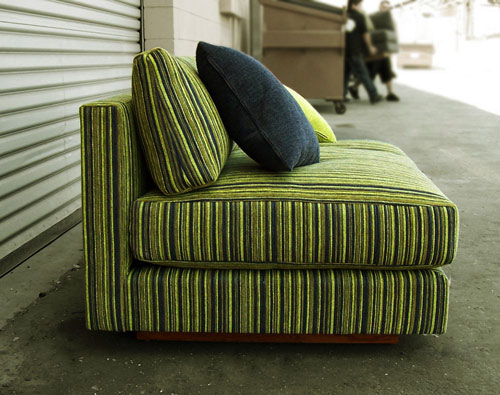








Cool looking couch, but I would not call viscose an “exemplary green material”. While definitely good that it is made from a renewable material, I do not call cutting down forest “green”. Also, viscose is a form of rayon and while I’m sure the industry is much better today, we have some super fund sites in the US that use to be rayon plants.
My thoughts exactly, Tipper – according to Wikipedia, viscose is not at all green: “Viscose currently is becoming less common because of the polluting effects of carbon disulfide and other by-products of the process, forcing some factories to close.”
http://en.wikipedia.org/wiki/Viscose
Thanks for the comments! It is nice to see there are people who research this stuff, and just don’t take someones word for it. I would however like to shed some light on the topic.
Our textiles are produced in Germany. The base or foundation for their viscose is from beech wood. This wood comes from an environmentally sound, harvested plantation located in Austria. These trees are grown and harvested in a responsible manner and managed with care for the land – an
important first start to their production. Since beech wood is a renewable resource and a local natural plant, it’s a great ingredient for this fiber.
The process of turning the beech wood into a viscose is a major accomplishment, and to do this under the strict guidelines of the producer we use is an even a greater achievement. The facility is state of the art and uses methods that no other company uses.
For instance, the comment above refers to Wikipedia’s general statement of carbon disulfide and other by-products. This is correct, but not with our manufacturer. Many years ago our manufacturer developed an almost completely closed process for the raw materials being recovered. In addition to this, they eliminated the use of chlorine, which was one of the main pollution problems in this process. The chlorine was actually replaced with oxygen.
I would also like to comment about location. The plantation, pulp mill, and fiber plant are very close to one another. This is generally not the case for most fiber producers. Since they are all close to one another, there is a very low carbon stamp with respect to the transportation of raw materials.
The mill has been around since 1925. They are still a family owned company. They recycle, not just paper, but water, yarns, spools, and many items on a daily basis. Their homes have solar energy, and so does the mill. They truly practice what they preach.
If anyone has further questions, they can contact us at MASHstudios.
Thank you for your comments.
Bernard Brucha
Principal, MASHstudios.