The K90 Table and Tiago Collection represent the inaugural collaboration between Davis Furniture and German design studio KASCHKASCH. United by an emphasis on material honesty, purposeful construction, and restrained form, the two collections distill complex engineering into furniture that feels both effortless and enduring. The K90 Training Table is defined by a sculptural leg that combines a slender flat steel profile with integrated material options, creating a distinctive architectural expression, while Tiago, a family of stacking chairs and barstools, highlights the expressive relationship between solid wood and molded plywood. Founded in 2011 by Florian Kallus and Sebastian Schneider, KASCHKASCH blends woodworking traditions with contemporary product design to create furniture that is both highly functional and rich in character. In this interview, the designers reflect on the development of both collections, their collaboration with Davis Furniture, and bringing their work to the North American market for the first time.

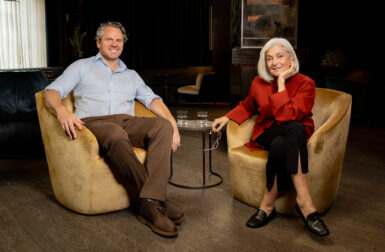
Trained as cabinet makers, Florian Kallus and Sebastian Schneider refine Tiago’s design through hands-on prototyping and material exploration. Photography courtesy of Davis Furniture.
Design Milk: For those being introduced to your studio for the first time, how would you describe your overall design approach and philosophy?
Sebastian Schneider: We try to strip design down to the bare essentials, which allows us to focus on what matters most. Products tell stories, and we want to bring those to life. As a German design studio, we cannot completely abandon our roots in the principle that form follows function. But for us, the formal design of a product is just as important. We strive to combine this perfect balance, or symbiosis, of functionality and emotion in our products, to give them a character of their own.
Florian Kallus: We are both trained as cabinet makers and that is where our roots are. Our design approach is very much hands-on, and we are always looking for the perfect balance between beauty and functionality.

K90 introduces a new material expression to the training table, pairing sculptural steel legs with integrated material options that bring warmth and character to collaborative environments. Photography courtesy of Davis Furniture.
DM: The K90 Training Table and Tiago Collection mark your first collaboration with Davis Furniture. What aspects of Davis’ approach to design and manufacturing resonated most strongly with your own way of working, and how did their design team influence your approach to developing the two products?
SS: I fondly remember when we first met the team at the Davis Campus in High Point. The first thing that really convinced us was the human aspect. You sometimes work on a project for several years, and at times very intensively, so it’s no fun at all if you don’t get on and find each other likeable. The family atmosphere at Davis really won us over. Then, of course, there were the products themselves and the wide, comprehensive production site. In our view, they are spot on in terms of both quality and design. Not too much and not too little. That’s exactly what we always try to achieve. So, it quickly became clear to us that we could work really well together.
FK: It’s always a pleasure to work with professionals, and the Davis team is definitely one of the most professional companies we have worked with in our 15 years in the design industry. Their input during the development phase had a huge impact on the final result.

Twin steel legs frame a central wire management panel, while power access is intentionally positioned at the edges of the tabletop to preserve an uninterrupted central work surface. Photography courtesy of Davis Furniture.
DM: What is the primary inspiration behind the K90 training table, and what problem were you most focused on solving?
SS: The inspiration for the K90 table was a ballerina who seems to glide elegantly across the room on her toes. We wanted to capture that elegance and lightness in the design. However, we aimed to keep it as simple and uncomplicated as possible, without having to invest thousands of dollars in tooling, creating a product for a very broad target audience. The biggest challenge was ensuring that this light, delicate structure is also stable, and that all the technical requirements, such as wire management, can be accommodated within it.

Every component of K90 was carefully prototyped and refined, allowing KASCHKASCH to resolve every detail, from the sculptural bent steel leg to the precise integration of the casters and wire management. Photography courtesy of Davis Furniture.
DM: Are there any signature features or design elements that define K90?
SS: There are plenty of them. For one thing, the flat steel legs certainly stand out, bending elegantly into shape, and the way the casters meet each leg precisely. Then there is the visually three-part structure between the two curved leg strips and the central wire management panel. It divides each leg into segments, making it appear less flat and bulky and emphasizing the two fine outer lines.

Designed for adaptable learning and workplace environments, the K90 Table features a 90-degree flip-top surface for compact nesting and storage. Photography courtesy of Davis Furniture.
DM: What role did materiality play in the design of K90, and how did you approach elements that carry both structural and visual weight?
FK: A major role. Because we wanted to create this sleek, elegant look and therefore needed very slim cross-sections, steel was really the only option. Aluminum would have been too soft. The steel legs run in a single sweep from the base almost all the way up to the underside of the tabletop. They channel the weight from the outside towards the center, both structurally and visually. The division of the leg into three sections – steel band, wire management cover, and steel band – creates a rhythm that makes the otherwise solid leg appear light and brings the fine lines even more into focus, particularly when the cover is made of wood veneer.

The interplay of molded oak veneer and solid oak gives Tiago its distinctive character, balancing soft curves with refined linear transitions. Photography courtesy of Davis Furniture.
DM: What is the primary inspiration behind Tiago, and what problem were you most focused on solving?
SS: With Tiago, we wanted to create an incredibly comfortable wooden chair. It quickly became clear that we would use molded plywood in the seat and backrest to achieve that comfort. Consequently, we were faced with the exciting challenge of determining exactly how the molded plywood back would connect to the solid oak leg. For us, the most important design feature was the transition from the rear leg to the backrest, which had to take the form of a soft, flowing curve and be visually appealing from every angle.

From sketch to full-scale prototype, Tiago took shape through an iterative process of making and refinement, with each adjustment bringing greater clarity to its proportions, silhouette, and comfort. Photography courtesy of Davis Furniture.
DM: What role did proportion and silhouette play in ensuring the chair feels both approachable and efficient in use?
FK: Proportion was really important to us right from the start. After all, we wanted to create an incredibly comfortable chair, so naturally it had to look the part too. We pushed 2D veneer to its absolute limits to achieve the greatest possible curvature in the molded components. Soft, flowing seat and back shells invite you to sit down and lean back. We also pushed the cross-sections of the legs and frames to the minimum to create the perfect balance between stability and visual lightness.

The Tiago Collection balances familiarity with a distinctly modern point of view. Photography courtesy of Davis Furniture.
DM: Designing a wood chair that stacks reliably presents unique challenges. How did you approach resolving them?
SS: That’s certainly true. Although we’re trained woodworkers and still work with wood almost every day, this collection really pushed us to our limits with its requirements. I felt that everyone involved learned something new from this project. In particular, the standards of the American market were new to us, and we first had to familiarize ourselves with the load tests before working with the engineers to find suitable solutions. After all, Tiago wasn’t meant to be too bulky, but to remain as slim as possible.

The Tiago Collection includes stacking chairs and barstools with an optional upholstered seat. Photography courtesy of Davis Furniture.
This is sponsored content presented in partnership with davisfurniture.com.