

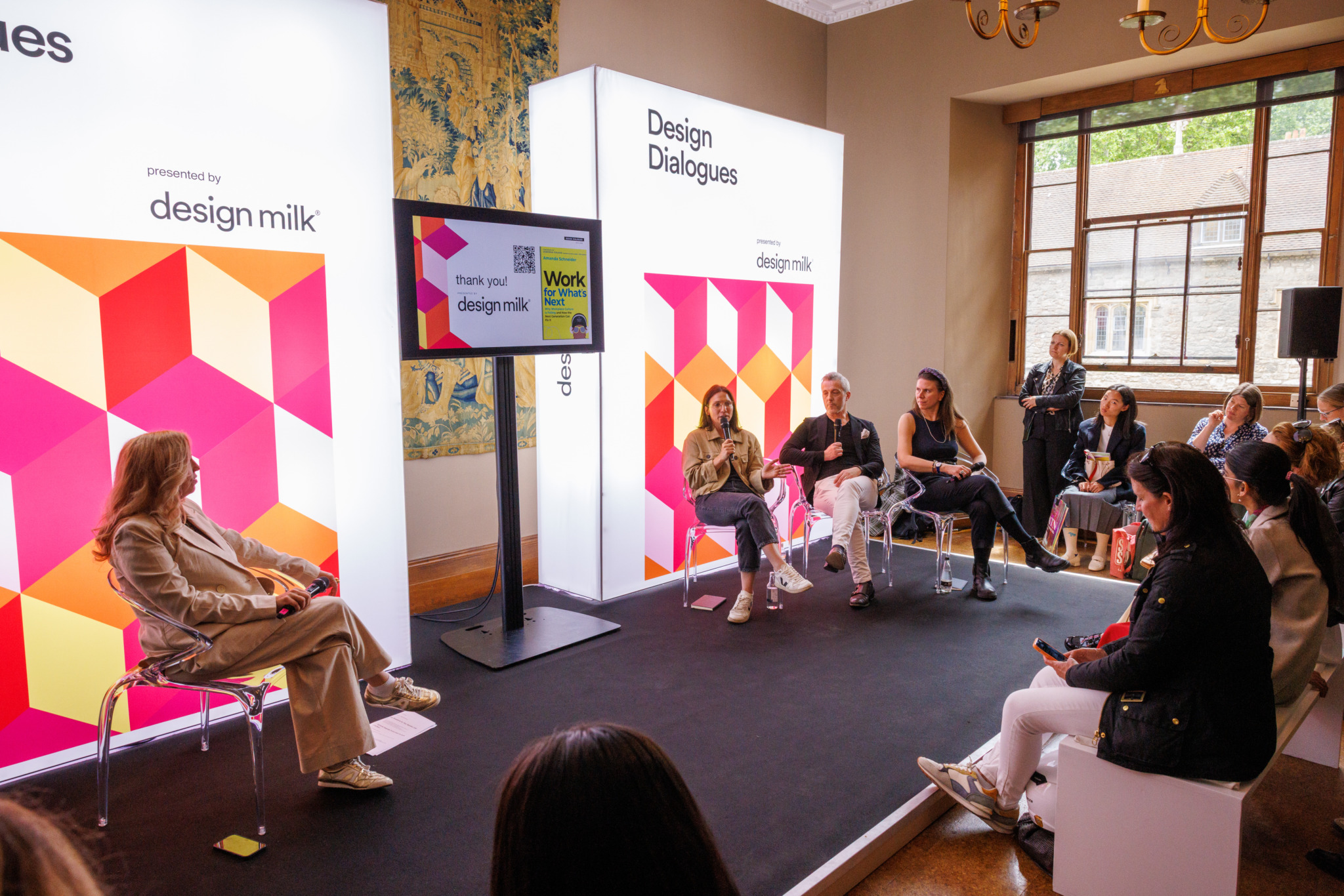

At Design Milk, we believe that design evolves through the exchange of ideas. As a platform for design inspiration and discovery, we love getting designers excited about new frontiers in design today. Last month, a festival of design in London provided the perfect platform for us to bring leading architects, emerging designers, technologists, social scientists, and media gurus together for three days of dialogue.
With hundreds of events and special activities, Clerkenwell Design Week is the UK’s most vibrant gathering for design. At this year’s edition, held 19-21 May, Design Milk contributed to the creative energy with Design Dialogues: a series of talks and conversations about cutting-edge concerns and topics in design practice today. The Design Dialogues were hosted by Joseph P. Sgambati III, deputy editor of Design Milk; Hannah Feniak, managing editor of Architizer, and AJ Paron, EVP and Design Futurist, SANDOW Design Group. Here are some of the topics they covered:
Neurodiversity and Immersive Spaces
Adipat Virdi speaking at Clerkenwell Design Week. Photograph by Sam Frost ©2026 – www.samfrostphotos.com
Noted immersive experience designer Adipat Virdi returned to Clerkenwell Design Week this year with a compelling presentation on the role of empathy in a world of AI and mixed reality. He was joined in conversation by Gamma Basra, Senior Partner and Head of Visualization at Foster + Partners; Andrew Reid, SVP of Commercial and Creative Strategy at Jack Morton, and Mark Jeffrey, Creative Director at Vision Tank. You can read more about Virdi’s perspectives here.
Empathy for lived experience also lay at the heart of AJ Paron’s talk, which presented a new framework for neuro-inclusive design informed by four cognitive profiles of Autism. Paron, who is a leading expert on design for autism, was joined in conversation by Alexandra Cleator, a director of Be Kind Research. Paron and Cleator elaborated on how the “high vs. low sensitivity” model for design for neurodiversity is being outmoded by emerging research on the traits of autistic people and the contexts within which they live.
Experience design and neuro-inclusive perspectives came together in “The Post-Neuro Office,” a panel discussion about designing workplaces around cognitive load, focus, and long-term mental stamina. The panelists included Chiara Cantilena, Head of Interiors and Senior Associate, LOM; Megan Dobstaff, Principal and Design Director, Gensler; and Dr Katie Gaudion, Design Consultant and Senior Research Associate, Royal College of Art’s Helen Hamlyn Centre for Design.
Design For This Generation and the Next
Six years after the outbreak of the COVID-19 pandemic, organizations around the world are finding themselves operating in a completely different workplace paradigm. In “Designing for a Workforce That Doesn’t Fully Trust the Office,” Joanne Sanger, Associate Interior Designer, Resonate Interiors, and Mijail Gutierrez, Design Director, Perkins&Will, debated the ins and outs of postpandemic offices with AJ Paron. Putting themselves in the shoes of Gen-Z, which entered the workforce where hybrid work and flexible schedules were the norm, they asked how workplace design must evolve as this next generation hits their stride as employees.
The panel discussion on “Designing for Gen Alpha.” Photograph by Sam Frost ©2026 – www.samfrostphotos.com
A second generation-focused panel gazed into the crystal ball and speculated on the kinds of spaces Gen Alpha might like to live, work, learn, and relax in. Paron was joined by Elisa Cecilli, Strategic Foresight Lead, Perkins&Will & Portland Design; Jo Rowan, Associate Director of Strategy at Priestman Goode; and Lee Roberts VP and principal at Zebra Projects, to debate the design preferences of an AI-native generation.
Responsible Materials and Nature-inspired Spaces
Sustainability threaded through a series of conversations facilitated by Architzer’s Hannah Feniak. In “Beyond Biophilia: The Next Phase of Nature-Integrated Design,” Oliver Heath of Oliver Heath Design Studio shared how his practice considers birds, plants, insects, soil, and other elements of the ecosystem as equal stakeholders. John Bushell, principal at KPF, spoke to integrating nature at the urban scale and developing climate-responsive cities, while Sarah Dabbs, studio operations director at SpaceInvader explained her approach to low-impact interiors—combining biophilic design with reuse, repair, and waste diversion.
Design leaders discussed diverse material strategies on the panel “Future Nostalgia: Reinventing Materials.” Arthur Mamou-Mani explained how his studio has an in-house fabrication and recycling facility where he and his team experiment with combining digital tools and design for circularity. Catarina Kohut of Tuckey Design Studio spoke to prioritizing place—and earth—in architecture projects while Colin Macgadie, founding director of of ForEveryday.Life and chair of the USM Futures Lab, shared his experience of re-orienting global real estate portfolios away from ground-up construction and towards reuse of existing buildings and materials.
Design brands that provide materials for building products and projects also took the stage at Design Dialogues. Cristina Stefani, Marketing & Communication Strategist, Aquafil, showed attendees how they can make an impact through specifying fully regenerated Econyl nylon fiber, while April Renee Graves, Partner at Aria Stone Gallery, celebrated the nuances of specifying natural stone as a way of practicing earth-centered design.
Design Process and Business Today
Rounding out the Design Dialogues programming, a series of talks addressed the creative and strategic concerns of design firms and studios: creative collaborations, iterative design processes, and brand building.
Hannah Feniak facilitates a panel on building design brands with integrity.
Marketing and Communications leaders, speaking on the panel “True to You: Building a Design Brand with Integrity,” asserted a shift in how design studios are growing their practices today and getting noticed. Consultant Ayo Abbas underscored how a firm’s work culture and decisions do more to build its market presence than logos and websites, and Caro Communications’ Anya Cooklin-Lofting seconded this by pointing out how valuable it is for clients and the public to get to know the real people behind a firm’s projects. Sophie Irvine, head of finance and operations at the Glasgow-based, employee-owned firm Collective Architecture, vouched for this idea. Her firm’s identity is tied to how it works and who forms the team, rather than any particular design style or process.
Artisanal processes and craft collaborators were represented on a panel hosted by Design Milk’s Joseph P. Sgambati III. A global authority on the use of leather in architecture and interiors, Bill Amberg of Bill Amberg studios shared his firm’s work and showcased the role of material expertise in shaping a truly unique design practice. He was joined by Shay Alkalay, cofounder of the much-feted Raw-Edges Design Studio, which has created products, limited edition offerings, and installations for global brands like Louis Vuitton, Vitra, Mutina, Kvadrat, and others.
Billy Mavropoulos and Katerina Dionysopoulou, founders and directors of Bureau de Change architecture, joined Sgambati to let attendees in on how their firm leverages rapid experimentation for its award-winning projects. They prototype, test, and fabricate endlessly, creating fascinating combinations of materials and fabrication processes.
With perspectives from large firms, boutique studios, and individual leaders representing many different areas of expertise, the 2026 Design Dialogues offered attendees a snapshot of how design studios are preparing to meet the challenges of a rapidly transforming world.