Inside the iF Design Trend Report 2026: Why Human Creativity Still Matters in the AI Era
The following post is brought to you by iF Design. Our partners are hand-picked by the Design Milk team because they represent the best in design.

As conversations around artificial intelligence continue to dominate the design world, the newly released iF Design Trend Report 2026 arrives at a particularly timely moment, offering a framework for understanding how designers are responding to a rapidly shifting landscape shaped by AI, automation, ecological urgency, and changing cultural expectations.

Each year, the Trend Report’s release coincides with the annual iF Design Trend Conference. Held in Berlin at the Frank O. Gehry-designed AXICA Conference Center, the sold-out conference brings together design leaders, strategists, technologists, and creative decision-makers to exchange ideas on the forces shaping the future of design. This year’s event centered on the dialogue between human creativity and artificial intelligence, a theme that reflects the Trend Report’s larger exploration of how design advances through friction.

Rather than framing the future of design as a straight line driven solely by technological advancement, the report argues that innovation increasingly emerges through contradiction, creative friction between trends, and the responses to them. That idea forms the basis of this year’s report, which organizes where design is heading around four major “trend pairs”: Age of Average vs. Recoupling Design, Convenience Culture vs. Skillization, Next Nature vs. Human Enhancement, and Unfolding Cities vs. Urban Villages.

For readers looking to go deeper, the 300+ page iF Design Trend Report 2026 offers the research, expert perspectives, case studies, and global examples behind these tensions — not as a list of predictions, but as a way to better understand the pressures already reshaping design. Download the report for free until July 7th.

Among the report’s most resonant observations is the emergence of what it calls the “Age of Average.” As AI tools become integrated into nearly every creative workflow, algorithms trained on existing data naturally favor familiar aesthetics, proven formats, and recognizable visual languages. The result is a growing sense of sameness across branding, interfaces, products, and digital experiences.

But the Trend Report 2026 stops short of framing this as a crisis. Instead, it presents the phenomenon as a creative challenge — one that may ultimately push designers toward more intentional and emotionally resonant forms of work. Its proposed counterpoint, “Recoupling Design,” describes a growing interest in tactile processes, analog experimentation, handcrafted imperfection, and culturally grounded storytelling. In a world increasingly saturated with AI-generated outputs, the report suggests that originality may come less from technical polish and more from perspective, emotion, and specificity.
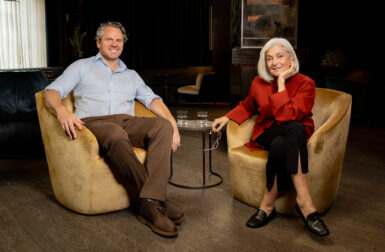
That idea also surfaced throughout this year’s iF Design Trend Conference, where speakers explored how designers can maintain individuality in increasingly algorithmic systems — and why human imperfection, materiality, and lived experience may become more valuable in the age of automation. Borja Martinez Pérez, founder of the Barcelona-based studio LO SIENTO and one of this year’s expert contributors to the report, addressed this directly in “Hand Thinking,” a presentation on manual and artisanal work as a conscious countertrend to what he refers to as the “digital tsunami”. His talk offered a clear expression of one of the Trend Report’s main learnings: originality may depend not on resisting technology outright, but on reconnecting design to touch, context, culture, and distinctly human ways of making. The quirks, imperfections, and lived experiences unique to people are precisely what AI cannot replicate.

For younger designers entering the profession, the report offers a reassuring takeaway: technical proficiency alone will no longer define creative value. AI may accelerate workflows and generate endless visual variations, but qualities like emotional intelligence, cultural awareness, and critical thinking remain distinctly human strengths. At the same time, established professionals are challenged to reconsider long-held assumptions around efficiency, optimization, and authorship. Robert Hodgin, Brooklyn-based digital artist, Rare Volume co-founder, and contributing expert to the Trend Report 2026, addressed this tension directly in his Trend Conference talk, “Why Bother: Creativity After AI,” asking what gives creative work meaning when sophisticated outputs can be produced in seconds. Quoting his friend and designer Luka Schulz, he offered a fitting provocation: “Things that take no effort are hard to value.”

Elsewhere, the report expands beyond AI into broader societal and spatial questions. The “Skillization” framework critiques contemporary convenience culture, arguing that meaningful experiences often require participation, challenge, and learning rather than pure frictionless-ness. Another section examines how cities are balancing large-scale smart infrastructure with renewed interest in smaller, community-oriented forms of urban living. Across each theme, the report consistently positions design not simply as a tool for solving problems, but as a means of shaping relationships, behaviors, and cultural meaning.
What ultimately makes the iF Design Trend Report 2026 stand out — and what gave the conference much of its energy — is its refusal to reduce the future of design to technology alone. Instead, it argues that the designer’s role is becoming simultaneously more expansive and more human. As automation accelerates and AI-generated content becomes increasingly ubiquitous, the report suggests that authenticity, interpretation, and emotional resonance may become design’s most important differentiators.

As technology makes more things faster, smoother, and easier to produce, the more urgent question becomes: what will make design worth paying attention to? The report answers by looking at the frictions shaping design now, where the pressure toward speed, ease, and scale is met by a renewed need for originality, agency, context, and human meaning.
Download the full iF Design Trend Report 2026 to explore the research, expert perspectives, and global design examples behind these shifts — available free through July 7th.
This is sponsored content presented in partnership with if-designfoundation.org.