

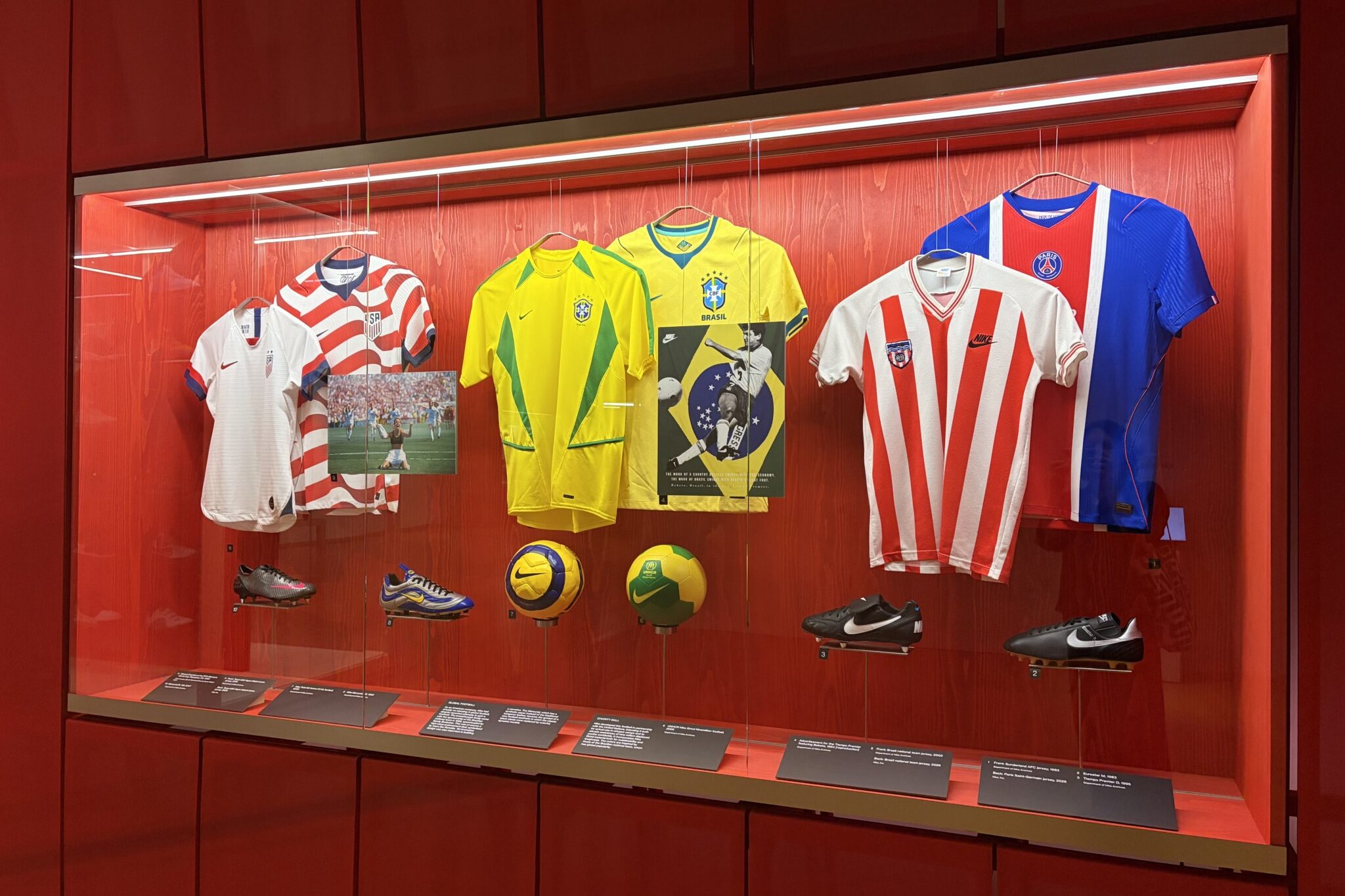


Is there any logo more iconic than the Nike swoosh? Unlikely. In fact, it’s arguably the most recognizable symbol in sports. But how did a small running company become a global powerhouse? Vitra Design Museum set out to find out, gaining unprecedented access to the Department of Nike Archives (DNA) to curate Nike: Form Follows Motion. First presented in Germany in 2024, the exhibition is now on view at the Museum of Arts and Design in New York through March 2027.

Photography by Bernhard Strauss; courtesy of Vitra Design Museum
Vitra Design Museum had been considering an exhibition about sports and design for years. When it approached Nike, the museum learned the extent of the company’s private archive, opening the door to a collaboration.

Photography by Bernhard Strauss; courtesy of Vitra Design Museum
“I was able to draw on the extraordinary depth and breadth of DNA’s holdings, including objects, documents, prototypes, study models, and material research, as well as some current designs from the company,” exhibition curator Glenn Adamson says.

Photography by Bernhard Strauss; courtesy of Vitra Design Museum
And what a time to bring Nike: Form Follows Motion to New York City, in a year when the Knicks won their first NBA championship in 53 years and the 2026 World Cup final was played just across the river.

Objects from Frank Rudy, who invented the Air Technology, from the Department of Nike Archives (DNA). Photography by Alastair Philip Wiper; courtesy of Nike.
“Having the exhibition travel right to the heart of New York couldn’t feel more appropriate,” Adamson says. “Nike has a very special relationship to New York City, going back at least to the early 1980s … when hip hop broke, coming out of Queens and Harlem. And the hip-hop community was very interested in streetwear generally, brands like Nike especially.”

A graffiti installation by Faust on the MAD Store doors. Photography courtesy of the artist.
Further connecting the exhibition to New York’s counterculture, renowned graffiti artist Faust, whose work is quintessentially NYC, created the cover of the book accompanying the installation and added his signature graffiti to the museum store door.

An early mechanical Shox prototype, c.1981. Photography from Department of Nike Archives; courtesy of Museum of Art and Design.
So what exactly is being exhibited at Nike: Form Follows Motion? Beyond the finished products most visitors will recognize, the exhibition focuses heavily on what usually remains unseen: prototypes, experiments, sketches, and design studies.
Familiar products like the Waffle Trainer, Air Force 1, Air Jordan, Air Max, Flyknit, and Vaporfly are displayed next to rare one-offs.

Various lasts, jigs, silicon pads, and
fixtures from Nike’s Advanced Product Creation Center. Photography by Alastair Philip Wiper; courtesy of Nike.
The exhibition is presented in four sections across two floors of MAD. “Track” explains Nike’s origins, founded in the ’60s by Phil Knight and his former track coach Bill Bowerman.
“Air” transitions to the ’80s, when Nike’s pressurized Air cushioning became a major focus of the company’s design development. The technology was made visible for the first time in the 1987 Air Max, and sketches, notes, and prototypes reveal how it evolved.

Photography by Bernhard Strauss; courtesy of Vitra Design Museum
Photo
“Sensation” explores the Nike Sport Research Lab, which studies the body in motion, evaluates the science behind the shoe, and examines Nike’s research into circular manufacturing, material sourcing, and recycling.
Finally, “Relation” is the exhibition’s grand finale, showcasing 50 transformative and often avant-garde footwear styles alongside hip-hop music videos, explicitly illustrating the correlation between Nike and streetwear culture.

A sketch of Air Max by Tinker Hatfield, 1986. Image courtesy of Nike.
“What’s really special … is that we have so many rarities from the archives,” Adamson explains. “That would include very early relics that are now unique objects [and] a lot of prototypes that show how these designs—which are very technically involved—were actually invented and developed.”
Thanks to the wealth of material from the DNA, including more than 200,000 objects that had never before been presented to the public as a curated collection, Adamson says the exhibition offers a glimpse of Nike’s “design process on the fly.”

Photography by Bernhard Strauss; courtesy of Vitra Design Museum
Nike: Form Follows Motion is on view at the Museum of Arts & Design in New York until Mar. 7, 2027.