



In 1926 in central Arkansas, an 11-year-old girl discovered what she assumed was just a “pretty rock”—it turned out to be a 27.21-carat diamond, which Tiffany & Co. ultimately acquired and dubbed the Arkansas Diamond. One hundred years later, that pretty rock has returned to its home state as a highlight of Nature Adorned: The Artistry of Tiffany & Co. and the American Imagination at Crystal Bridges Museum of American Art in Bentonville, Arkansas.

Discovered in Arkansas in 1926, the 27.21-carat Arkansas Diamond was acquired by Tiffany & Co. in 1946 and is among the largest diamonds ever found in the United States. Photography courtesy of Tiffany & Co. Archives.

The Arkansas Diamond is displayed alongside archival documents tracing the state’s diamond-mining history in Nature Adorned. Photography courtesy of Crystal Bridges.
The diamond’s acquisition reflects a longstanding Tiffany tradition. Under the leadership of George Frederick Kunz, the company’s first chief gemologist, Tiffany championed American gemstones at a time when European jewelers largely overlooked them. From sapphires sourced in Montana and tourmalines from Maine to emeralds from North Carolina, these stones reveal the geological diversity of the American landscape. The Arkansas Diamond is another example of that legacy.

An 1885–1895 Tiffany & Co. necklace features 30 multicolored American-mined tourmalines, a gemstone championed by the company’s first chief gemologist, George Frederick Kunz. Photography courtesy of Tiffany & Co. Archives.

A blue mineral specimen displayed against Carmen Herrera’s Cerulean illustrates the exhibition’s exploration of connections between natural formations and abstract art. Photography courtesy of Crystal Bridges.
Bringing together gemstones and jewelry from The Tiffany Archives with works from the museum’s collection, Nature Adorned explores how the natural world has influenced both jewelry and fine art. Through unexpected pairings, the exhibition reveals shared approaches to color, form, and craftsmanship across different mediums.

Installation view of Nature Adorned at Crystal Bridges, where gemstones, jewelry, and works of American art are presented in conversation with one another. Photography courtesy of Crystal Bridges.
“This exhibition reveals the power of seeing The Tiffany Archives and Crystal Bridges’ collection in conversation,” says Jen Padgett, Crystal Bridges’ Windgate curator of craft. “Through this collaboration, we can highlight the remarkable creativity, attention to materials, and skilled making that have shaped American art and design across generations.”
Inside the exhibition, this conversation begins in the garden. George Paulding Farnham’s orchid brooches balance the fluidity of the natural world with the precision of cut gemstones. Diamonds, emeralds, and pink sapphires are delicately placed among gold and enamel, capturing the flowers with botanical accuracy.

George Paulding Farnham’s Tiger Orchid brooch (1889–1893) combines gold, sterling silver, diamonds, emeralds, pink sapphires, and enamel to capture the flower’s intricate details. Photography courtesy of Tiffany & Co. Archives.

Martin Johnson Heade’s Cattleya Orchid, Two Hummingbirds and a Beetle (ca. 1875–1890) reflects the same fascination with botanical detail found in Farnham’s orchid jewelry. Photography courtesy of Crystal Bridges.
The brooches reflect the paintings displayed alongside them, including Martin Johnson Heade’s Cattleya Orchid, Two Hummingbirds and a Beetle. The paintings share the same attention to organic form and detail, making the two distinct works feel like an extensions of one another—and of nature itself.

George Paulding Farnham’s orchid-inspired jewelry is displayed alongside works of American art in Nature Adorned, highlighting a shared interest in the natural world’s intricate forms. Photography courtesy of Crystal Bridges.
Carmen Herrera’s Cerulean (1965) and Leon Polk Smith’s New Moon for August (1983) introduce a different interpretation of nature, where form is reduced to crisp edges and angles. The exhibition pairs these abstract works with faceted gemstones, drawing attention to the relationship between shape, line, and geometry.
A blue mineral specimen displayed against Carmen Herrera’s Cerulean illustrates the exhibition’s exploration of connections between natural formations and abstract art. Photography courtesy of Crystal Bridges.
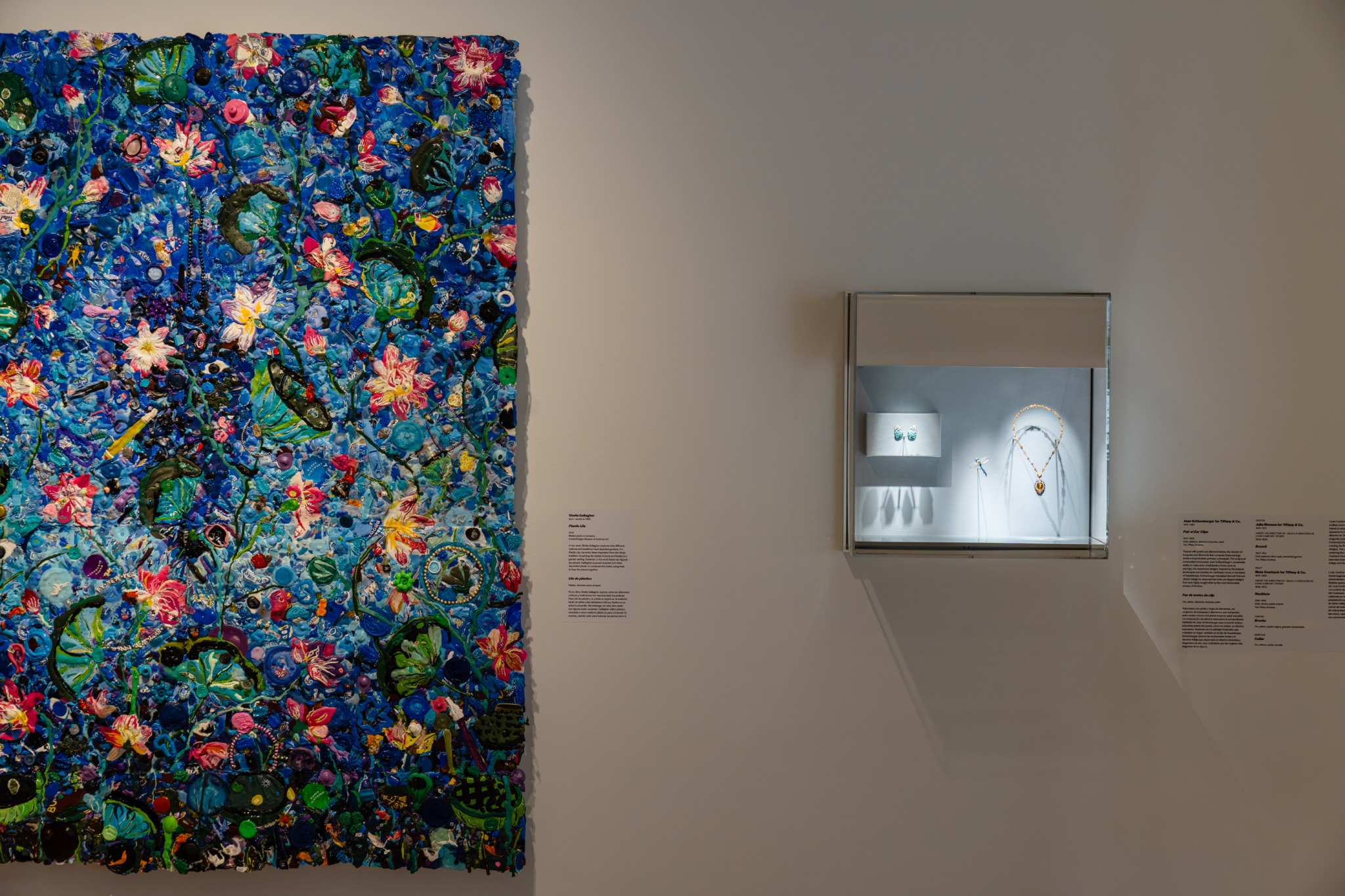
While Herrera and Polk Smith focus on precision, Jean Schlumberger lets loose. His rubellite and turquoise necklace, Hedges and Flowers, along with his tanzanite brooch, Bird on a Rock, capture what he described as the “irregularity of the universe.” Instead of taming nature, Schlumberger allows its unpredictability to take the spotlight. Hope Gangloff’s Queen Jane Approximately echoes this organic approach through lively colors and patterns, creating a visual dialogue with the jewels.

Jean Schlumberger’s Hedges and Flowers necklace (1978–1987) combines gold, platinum, diamonds, rubellite tourmalines, and turquoise in an exuberant interpretation of the natural world. Photography courtesy of Tiffany & Co. Archives.

Schlumberger’s Hedges and Flowers necklace on display at Crystal Bridges, where its organic forms are presented in dialogue with works of American art. Photography courtesy of Crystal Bridges.
Victoria Reynolds, Tiffany & Co.’s chief gemologist and vice president of high jewelry diamond and gemstone acquisition, describes the exhibition as a celebration of the company’s heritage, highlighting “the enduring influence of nature across generations of creativity.”

Jean Schlumberger’s Bird on a Rock brooch (1965) pairs a diamond-studded bird with a striking tanzanite gemstone, transforming a familiar natural subject into an imaginative piece of jewelry. Photography courtesy of Tiffany & Co. Archives.

Hope Gangloff’s Queen Jane Approximately (2011) uses expressive color and pattern to explore organic forms, echoing the playful approach to nature found in Jean Schlumberger’s jewelry. Photography courtesy of Crystal Bridges.
Nature Adorned: The Artistry of Tiffany & Co. and the American Imagination is on view through Mar. 29, 2027, at Crystal Bridges Museum of American Art in Bentonville, Arkansas.

Now Trending




Reviving an Enduring Emblem of Simplicity, Loll Designs Launches the Here and There Collection
Developed in collaboration with design studio Argenta Park, the “people and nature first” brand reprises conservationist Aldo Leopold’s humble yet ingenious bench as a family of low-maintenance, sustainable outdoor furnishings.