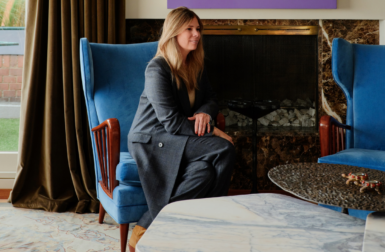
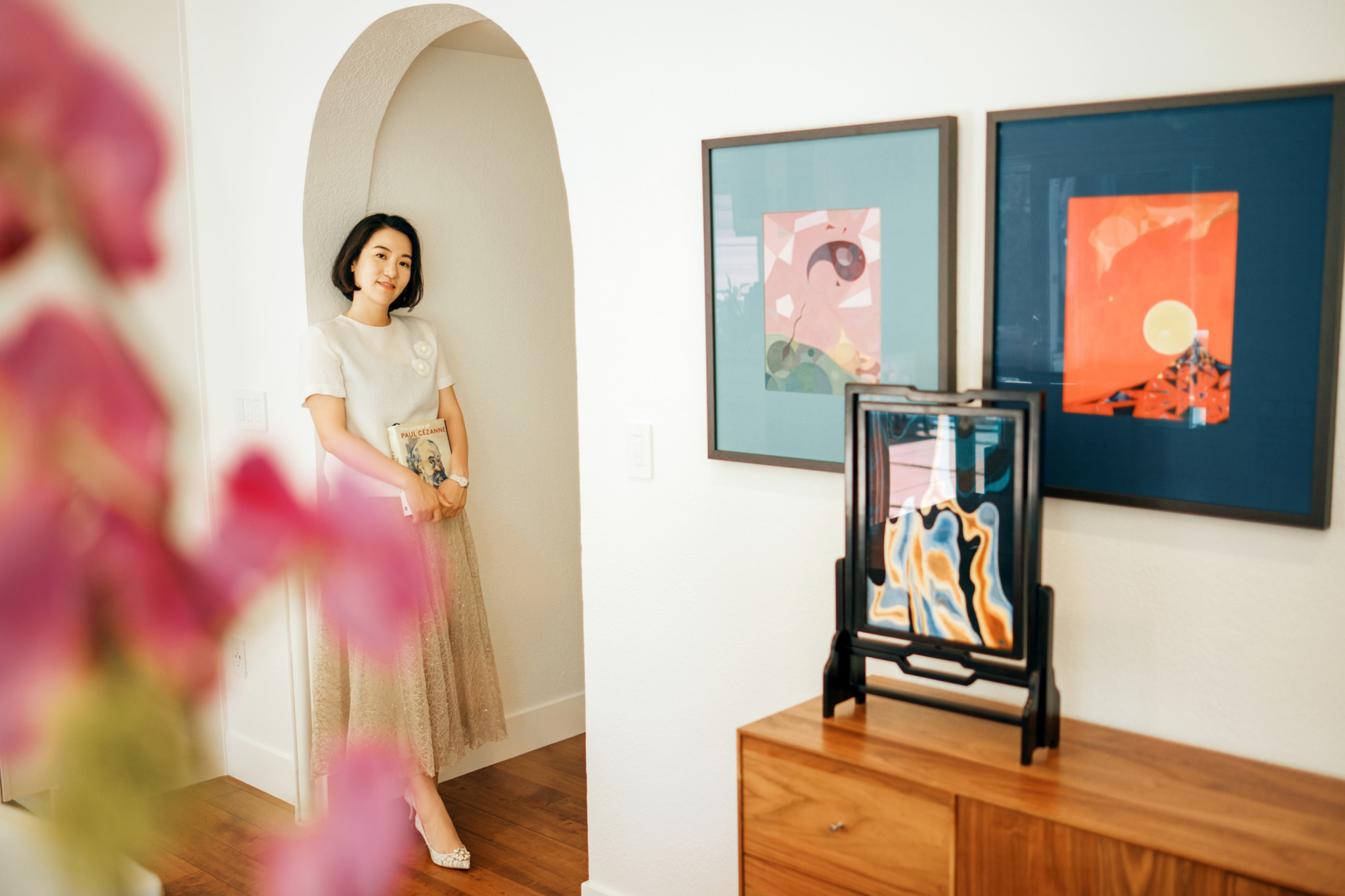


With a demanding finance career and a parallel practice as a visual artist, San Francisco-based Grace Zhang moves between two seemingly different worlds. But both involve looking for patterns and making sense of complexity. A graduate of Columbia University’s international affairs program, Zhang sees painting as a counterpoint to her work in finance, a “way to decompress from the intensity of the markets.” She also designs original jewelry and fine watches, drawing inspiration from Paul Cézanne’s structural approach to color and form.
Zhang’s paintings reflect a wide range of influences, from her world travels and love of haute couture to Buddhist philosophy and Cézanne. Saturated, contrasting colors, geometric forms, and dot-and-wave motifs appear throughout her work, while her self-portraits nod to Chanel and Dior. Yet the singular creative work that has left the deepest impression on her is Johann Sebastian Bach’s “Fugue No. 24 in B minor.”
“What I love about [that piece] is the balance between structure and emotion,” she explains. “…weaving together into something extraordinarily intricate yet harmonious. I’m fascinated by how something so carefully constructed can also express such profound feelings.”

Photography by Brendan Mainini; courtesy of Grace Zhang and GCS Agency
Zhang also seeks that balance between order and emotion in her paintings, bringing “complexity and order, but also tenderness, passion, and a quiet sense of transcendence” to her work. She explores questions of life and death, the earth and the universe through the lens of Buddhist teachings. Her newest series, Aurora Undae Country Club, brings together her fascination with the cosmos and her love of golf, imagining the sport as “a portal between earthly experience and cosmic space.”
For today’s Friday Five, we spent five minutes with Grace Zhang discussing her current exhibition, Spacetime Monologue, on view at the GCS Agency gallery in San Francisco through Oct. 25.

Photography by Brendan Mainini; courtesy of Grace Zhang and GCS Agency
‘Spacetime Monologue’
Zhang’s first public exhibition of paintings includes 32 works spanning several bodies of work: haute couture-inspired self-portraits, paintings interpreting science and financial markets, and the golf series.
“At the heart of my painting is a search for the underlying structures and principles of the universe, a sense that beneath everything around us lies a deeper truth,” Zhang says. “I embrace the complexity of lived experience: the constant flow of impressions, stories, and encounters, alongside my interests in travel, fashion, financial markets, and much more.”
She describes her work as “Buddhist philosophy meets the structural logic I find in Cézanne.” Her Bloomberg Terminal and canvas sit side by side, “so I’m constantly moving between the two worlds,” she says. “They may seem completely different, but both are about looking for patterns, understanding cycles, and making sense of what can initially feel like chaos.”

Installation view of ‘Spacetime Monologue.’ Photography by Brendan Mainini; courtesy of Grace Zhang and GCS Agency.
What Inspired ‘Spacetime Monologue’
“My paintings seek underlying structures across different disciplines and experiences,” Zhang says. “Some begin with science, others with travel or financial markets, but dots and waves recur throughout the work, connecting these different starting points.”

‘Quantum Whisper’ by Grace Zhang. Photography courtesy of the artist.
The Duality of Light
In the famous double-slit experiment, light passing through two narrow slits produces an interference pattern characteristic of waves. When measured to determine which slit each photon passes through, that interference pattern disappears, revealing light’s particle-like behavior. This sparked Zhang’s curiosity.
“I was drawn to the idea that something as fundamental as light can be both at once, and that the act of looking changes what we see,” she explains. “In Quantum Whisper, dots and waves become a visual language for this duality, shaping both the composition and the painting’s quiet, mysterious atmosphere.”

A view of the Lijiiang village. Photography by Grace Zhang.
The Mountain Sky
While traveling in Lijiang, Zhang was intrigued by Jade Dragon Mountain’s jagged outline against the sky, which led to her painting Jade Hash.
“Its ridgeline reminded me of the market charts I watch every day, from cryptocurrency to U.S. debt,” she says. “In Jade Hash, the mountain’s silhouette becomes a simplified outline of the market’s peaks and troughs, a wave-like form connecting the landscape with the rhythms of finance.”

‘Jade Hash’ by Grace Zhang. Photography courtesy of the artist.
Elliott Wave Theory
Working in finance, Zhang became interested in Elliott wave theory, a form of technical analysis that proposes markets move in recurring wave patterns influenced by collective investor psychology, including fear and greed, despair and euphoria. She says that “the idea that something as chaotic as a market might have an underlying rhythm” sparked her creativity.
“In my paintings, those cycles become waves, rising and falling across the canvas, and they carry the same emotional swings,” she explains. “It shapes both the form of works like Jade Hash and their atmosphere.”

‘Self Portrait I’ by Grace Zhang. Photography courtesy of the artist.
Chanel Haute Couture Spring-Summer 2021, Look 5
“My first Chanel haute couture jacket became the starting point for my first self-portrait, Self Portrait I. I appreciate its wave-like pattern, which I interpreted through the wave nature of light,” Zhang explains. “In the painting, its blue and yellow tones sit against a red, universe-like background, while the jacket’s reflective details are transformed into stars.”

‘Self-Portrait—One Night at Dar El Bacha’ by Grace Zhang. Photography courtesy of the artist.
Chanel Haute Couture Spring-Summer 2024, Look 45
Self-Portrait—One Night at Dar El Bacha features a Chanel look from the SS24 haute couture collection. “I connect it to my travels in Morocco and to the geometric traditions of Islamic art,” Zhang says. “In the painting, the dark ensemble and its colorful embellishments evoke the night sky and humanity’s fascination with the cosmos.”