

In the current design landscape, collaboration has become a language unto itself, often compromising more considered ideas for quick commercial success. Fashion houses court architects, furniture brands invite artists into the studio, and retail giants translate the vocabularies of established designers into objects that can move far beyond the collectible gallery or rarefied residential interior. The results are mixed: some collaborations flatten a designer’s voice into surface treatment, while others open a more democratic path into a fully formed world.
Kelly Wearstler’s forthcoming collaboration with H&M HOME belongs to the latter category. Having debuted through a conceptual installation during Milan Design Week, the collection marks several firsts: H&M HOME’s first appearance at the fair, Wearstler’s own Milan Design Week debut, and the brand’s first designer collaboration to include large-scale furniture alongside smaller design objects.
That shift in scale matters. Rather than treating the collaboration as a limited assortment of decorative accents, Wearstler and H&M HOME have built something closer to a spatial proposition. The collection includes objects and furniture in wood, metal, ceramics, marble, and textiles, extending Wearstler’s command of material, proportion, and atmosphere into a format designed for a broader audience. Pieces such as the NOXEN Modular Stool, ETRINE Marble Tray, CURVA Vase, and SOLUNA Lounge Chair suggest a vocabulary of strong silhouettes, tactile contrast, and sculptural presence. Each has its own personality, yet none feels isolated from the larger interior narrative.
“From the outset, the thinking was always spatial,” Wearstler explains. “Even though the collection exists as individual pieces, they were conceived in relation to one another — how they can be personalized to live together, how they shape a room, how they support the way people move through a space.”
That distinction is crucial. In a mass retail context, design is often asked to become more legible, efficient, and broadly palatable. But accessibility does not have to mean reduction. Here, the collection demonstrates emotional and sensory intelligence, bringing the nuance of a highly authored interior into objects that can circulate through many kinds of homes.
Wearstler describes luxury today as something less tied to material value alone than to experience, intention, and atmosphere. “In a mass context, the challenge is to preserve that level of nuance,” she says. “It’s not about simplifying the work, it’s about distilling it and bringing clarity to the idea so that it can exist at scale without losing its integrity.”
That clarity comes through in the collection’s emphasis on daily ritual and modular synergy. Furniture, in Wearstler’s view, is not merely something to be admired but something to be lived with over time. It should support identity, movement, and mood. “When you think about furniture as a companion, it has to be adaptable, it has to have longevity, it has to earn its place in someone’s life over time,” she says. “It’s not about a moment; it’s about a relationship.”
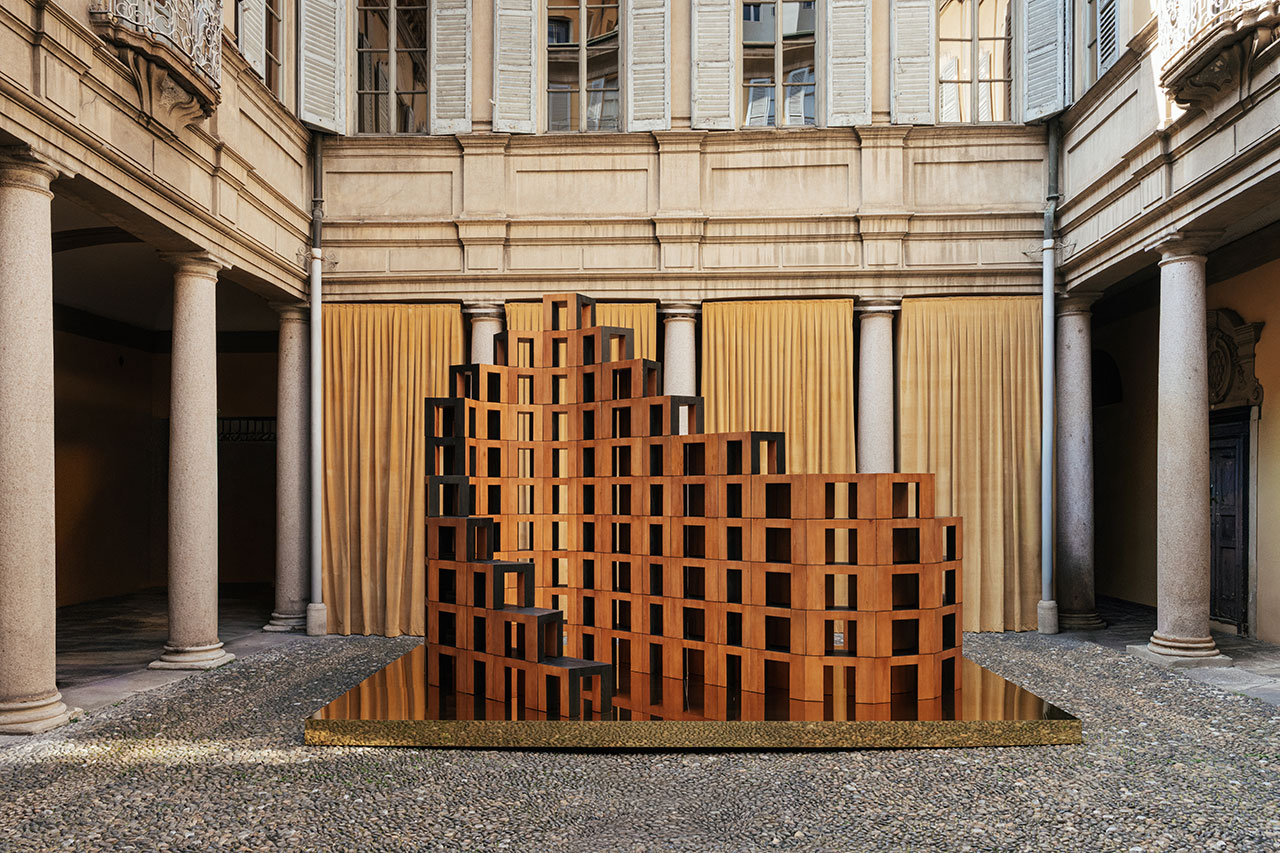
The Milan presentation made that relationship visible. Installed at Palazzo Acerbi, a 17th-century Baroque palace on Corso di Porta Romana that has long been closed to the public, the preview placed the collection in deliberate tension with architectural grandeur. Soaring columns and frescoed interiors became more than a dramatic backdrop; they sharpened the contemporary language of the work. Produced by Studio Boum, the installation unfolded as an immersive, choreographed journey through the senses, with each room exploring a different facet of the collaboration.
For H&M HOME, the setting signals a more ambitious design position. “This collection represents many firsts for us,” says Evelina Kravaev-Söderberg, H&M HOME Head of Design & Creative. “Having a presence at Milan Design Week has long been a dream, and with Kelly, we knew the moment was right.”
For Wearstler, the palace revealed something a neutral retail environment could not. “It created a dialogue between past and present, ornament and restraint, permanence and flexibility,” she says. “That contrast brought the collection into sharper focus. It showed that the work isn’t dependent on a neutral backdrop. It can hold its own, it can create its own atmosphere, and it can exist within a broader architectural narrative.”
That may be the collaboration’s most compelling achievement. It understands that collectible design is not simply a matter of rarity, price, or limited availability, but of authorship, material intelligence, emotional charge, and the ability of an object to alter the room around it. By bringing those qualities into a more accessible framework, Kelly Wearstler and H&M HOME suggest a different kind of democratization: design made more widely available without surrendering its atmosphere.
The Kelly Wearstler H&M HOME collection will be available beginning September 3, 2026, in select stores and online.
Photography by Piergiorgio Sorgetti, courtesy of H&M HOME.