
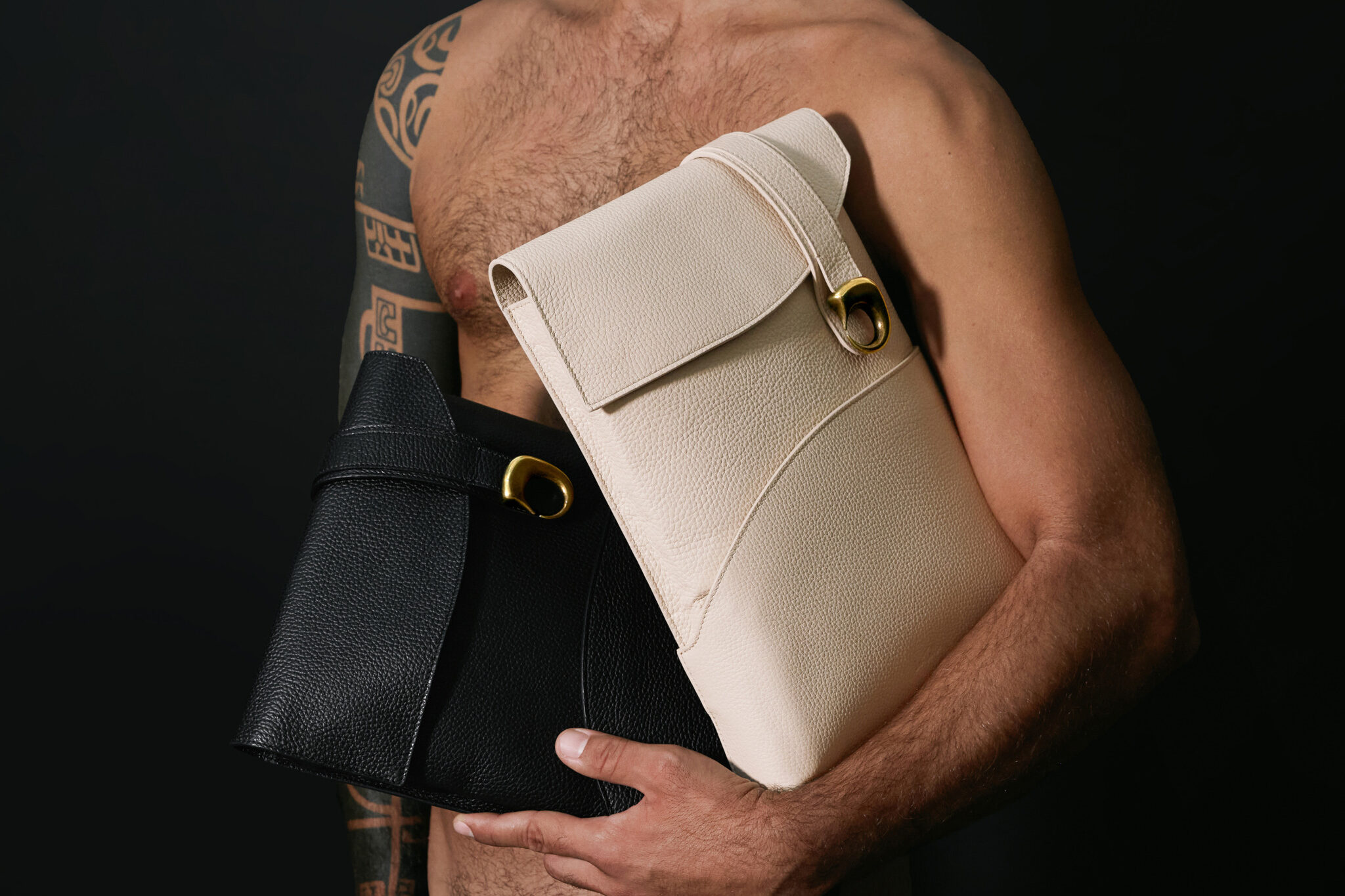


Les Tells founder Brianna Tell’s work is best explained by the intersections that inspire it. There’s the influence of her hometown of Lancaster, Pennsylvania, and her professional experience in Milan, Italy. There’s the intersection of experimental design and generations-old Italian craftsmanship. But perhaps the most important intersection is the one between bag and body. Where rigid corners and bulky silhouettes can cause discomfort, Tell wanted to explore what physical cohesion between bag and body could look like—a piece that functions not simply as an accessory, but as an extension of the wearer’s silhouette.

Photography courtesy of Les Tells
The result is the first collection from Les Tells: six luxury Italian-made bags and accessories designed to fit and complement the wearer’s body. Released on Nov. 3, the collection features four bags, a wallet, and a wristlet designed to follow the body’s natural curves. The idea was that an accessory could be luxurious and distinctive without the discomfort and awkwardness that can accompany high-concept design.

Photography courtesy of Les Tells
The idea came to Tell while she was visiting Paris. “I was watching all of these beautiful French people walking down the street as they are, and I just saw all of them in these beautiful outfits,” Tell recalls. “But then I saw some of the bags that they were wearing, and it just felt like they were sticking out from their body. That was the moment that I was like, why aren’t there bags that move better with your body?”
From there, she began the design process, sketching out silhouettes for crossbody bags and handbags. The concepts were distinctive, but the true test would come in how they moved with the body.

Photography courtesy of Les Tells
Tell’s approach to testing is, admittedly, a bit unconventional. Knowing the importance of how the pieces worked with a body in motion, she constructed paper models, testing out the bags’ mobility and identifying points of friction. The approach had its initial skeptics.

Photography courtesy of Les Tells
“I showed up with these paper models and [my friend] was like, ‘Nobody’s going to take you seriously. This is something that is not professional,'” she recalls. “But I still believed in this, and I wanted to keep on going. I went down and talked to those ateliers.”
She found a collaborator in a family-run atelier in Scandicci, near Florence. “They looked at me like I built something so different and unique that it really verified my gut feeling that I was on the right track.”

Photography courtesy of Les Tells
Over two years, she refined the designs. The Alexandras, a cylindrical bag with a detachable strap, has an inward curve designed to nestle comfortably against the wearer’s hip. The Logans, featuring an asymmetrical, oblong silhouette, is a crossbody bag designed to sit comfortably under the arm or along the curve of the back. The Kathleens, a shoulder bag, features a gentle curve that doesn’t compromise its interior capacity. Each design follows the same principle: structure without sacrificing comfort.

Photography courtesy of Les Tells
The decision to use Italian leather was inspired by Tell’s upbringing near horse farms in Pennsylvania, where leather was a familiar material, as well as her time studying in Florence. The hardware and jewelry were designed alongside the bags, echoing their forms and creating a cohesive finish. Offered in four colorways, Tell wanted to create a collection that felt both personal and universal—one designed to be worn across a range of genders and body types.

Photography courtesy of Les Tells
“In the campaign photos, there are different body types; there are different ages; there are different people,” Tell explains. “They get to decide if they want to wear that bag. It’s not me that says, ‘Okay, this is just for a woman.'”

Photography courtesy of Les Tells
Tell’s focus has remained squarely on design, down to the collection’s less visible details. To improve comfort and functionality, the “Les Tells” embossed tab on the Alexandras acts as a latch for the magnetic clasp that secures the flap. The Kathleens feature a hidden strap extender tucked inside the bag, plus a microfiber case for glasses. After two years of meticulous development, Tell believes the attention to detail has paid off. After all, you only get one chance to launch your first collection.

Photography courtesy of Les Tells
Tell has already started work on the next iteration, including a new set of the paper models that raised eyebrows when she began developing the debut collection. This time, however, she’s confident in the process that brought her designs to life. “I’ve had this gut feeling for so long that people are really going to appreciate the bags,” she says. “And I’m really ready to show the world.”

Photography courtesy of Les Tells
The Les Tells collection is now available at lestellsworld.com, with prices starting at $350.