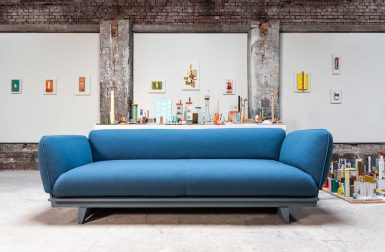
For this week’s Deconstruction, Danish designer Cecilie Manz shares numerous sketches of her new chair for Fritz Hansen, the Minuscule, which won the 2012 ICFF Editor Award in New York City this week. The name Minuscule represents the informal and understated style for which the Scandinavians are known. Although the notes that accompany Manz’s sketches are sparse (much like the chair itself), she talks more in depth in the video. Manz describes the chair as a formal design, meant for informal situations. She likens its rounded shape to a beach stone, and points out that the rounded back provides a sphere, or protected space for the person sitting on it. It’s a beautifully designed piece, very, very thin, thanks to current technology, but with hand stitched upholstery that harkens back to Old World tailoring. Follow its conception below.
Read more

Kartell’s Salone del Mobile stand showcased an iconic range of products, deconstructed. Every phase of the creative process was on show, from initial sketches, through prototyping to the final manufactured products.
Read more

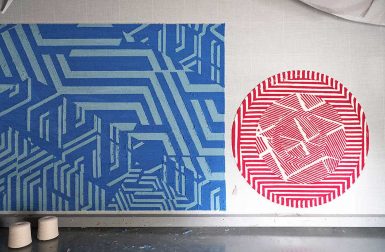
Today’s Deconstruction, “Megan Geckler for Bobble,” may be the most colorful one ever. Created by artist Megan Geckler, the subject is a unique art installation created and featured at the International Home and Housewares Show in Chicago this past March. The piece was commissioned by water bottle company Bobble to commemorate its second year.
Read more

From their studio in the heart of London, Black + Blum designers Dan Black and Martin Blum create products for the home and office, combining ruthless practicality with an intellectually-satisfying design aesthetic meant to charm and entertain. In this month’s Deconstruction, the duo provides us with a detailed look into the development of the Eau Good water bottle, which incorporates active charcoal to purify the water.
Read more

In January 2010 Bjørn Jørund Blikstad’s prototype for a modular storage system graced the cover of Wallpaper* magazine and then the pages of Design Milk. Two agonizing years later at February 2012′s Stockholm Furniture Fair, he finally launched Imeüble. I spoke to him about the long road from the inspiration to production.
How did the initial idea for Imeüble come about?
“The cube you can see with your mind eye, does it have storage capacity?” was a sort of headline for my research into storage and retrieval. I tried to establish a link between content and container, as an idea for storage design in general. Because what we seek to store or retrieve in our archives are vivid imagery from books, letters, photo albums, objects; it’s ‘the memories of’ that are important, not the symbols or objects themselves. So I researched for a system where the memories and the stored place of this memory making item came together. “Filed away, forever separate” [David H. Freedman, 2006]; quite the opposite from our minds where everything’s a mush.
Read more

Yorkshire-based furniture designer and maker Anthony Hartley describes himself as a “jumped up joiner” who started drawing and designing furniture while he was supposed to be doing other things at school and then never really stopped. For this month’s Deconstruction, Hartley walks us through the design and production process of his new range of dining and occasional furniture, called Cable. The pieces are made from clean and simple MDF or ply template shapes, sprayed in Hartley’s trademark strong color palette. The innovation comes in the joining of the templates, which uses multicolored cable ties to secure them, and which can be easily assembled without tools. Customers can order a matching set, a single base color with a mix of accents, or a completely custom colorway.
Read more

Flavor Paper makes hand-screened and digital wall coverings that can best be described as, well, flavorful. The range encompasses old-fashioned-turned-funky florals, hyper-realistic psychedelic scenes, and plain decorative fabulousness. You can even work with them to develop custom designs. In other words, Flavor Paper knows no bounds. The team let us grab a glimpse of their creative process inside their Brooklyn studio for this week’s Deconstruction.
Read more

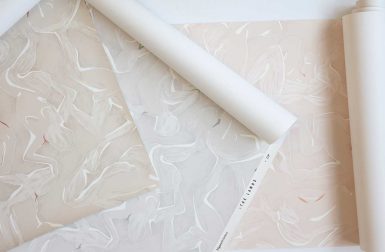
We have long admired artist Karen Combs’ lyrical swirls, doodles, and doodads that artfully land on her hand-done sheets of wallpaper. Her studio, Nama Rococo, which recently re-located from the Berkshires to the Hudson River Valley, turns out sheets of acid free French paper, hand painted and hand printed with artist’s pigments. For this month’s Deconstruction, Design Milk gets a glimpse of the printing process for Nama Rococo’s new Amsterdam pattern, from testing to the final product, complete with styled photo shoot. But first, if you’re curious about the quirky name, “nama” means “raw” in Japanese, and of course, one look at the designs and you see where rococo comes from!
Read more
This year’s Deconstruction posts were better than ever! If you’re not already Deconstruction savvy, these monthly posts feature the design process from some of the best and brightest designers from around the world in their own words and pictures. We’ve rounded up all the Deconstruction posts from 2011 in one place just in case you missed one. Click on the post titles below to take a behind-the-scenes look at the creative process of designing and manufacturing a product.

Fusillo by Marco Goffi
Fusillo is a seating design by Marco Goffi that aspires to facilitate social interaction and conversation in public spaces. Marco walks us through the process of creating his new design.
Read more

In this month’s Deconstruction, Design Milk gets a behind-the-scenes look at developing and constructing the Salon Armchair from British design darling Lee Broom. Broom, who has designed over 40 bar and restaurant interiors, and formed his own product design company four years ago, started out studying theater, than fashion design. Before he even attended Central St Martins he worked for Vivienne Westwood. This might just explain the enthusiastic studding on the furnishings of his newest collection. Let’s have a look how it’s made.
Read more