



ROOM’s Designers on Design series, an ongoing video platform pairing influential designers in unscripted dialogue about process, inspiration, technology, and the future of the built environment.
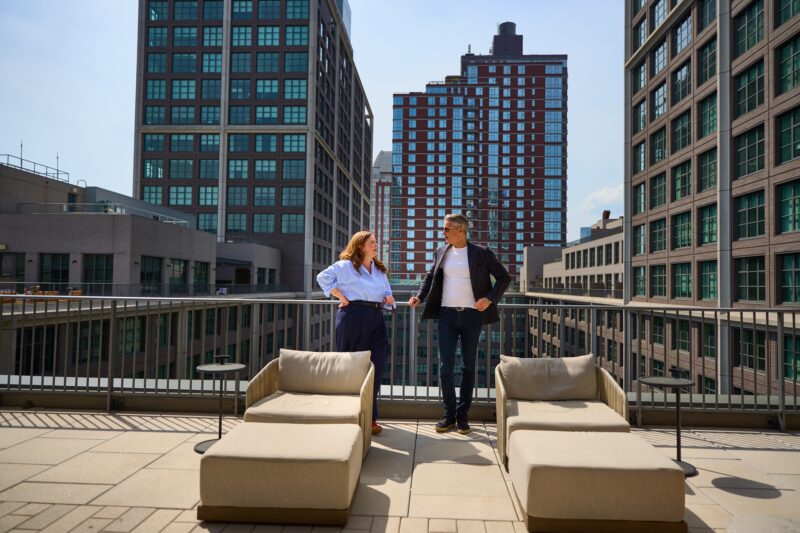
Following its inaugural launch at the International Contemporary Furniture Fair (ICFF) in 2025, the series returns with a third episode featuring Becca Roderick, Executive Director of Interiors at Morris Adjmi Architects, in conversation with Laurent Lisimachio, Director and Principal at Gensler. Filmed this spring at Front & York, Morris Adjmi Architects’ multifamily development in DUMBO, Brooklyn, the episode captures the pair discussing inspiration, technology, and the evolving role of design today.
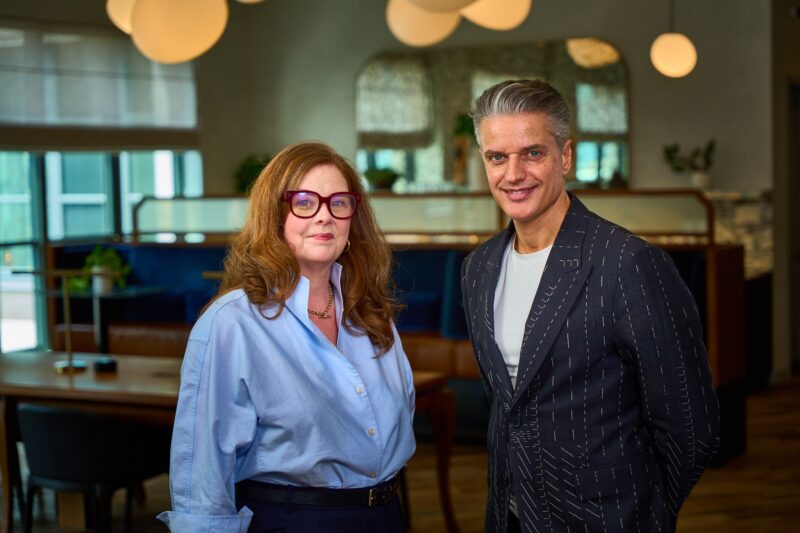
The premise behind Designers on Design is deceptively simple: pair designers together and let the conversation unfold organically. ROOM built the platform around the belief that “no one gets a designer quite like another designer,” a philosophy that becomes immediately apparent in Episode 3 as a casual exchange about New York expands into a broader discussion about creativity, mentorship, and emotional connection within design practice.
Throughout the episode, both designers return repeatedly to the idea that inspiration rarely arrives fully formed. Lisimachio, who moved from Paris to New York more than two decades ago, describes finding beauty not in overt grandeur but in the city’s grit: fleeting patterns of light across infrastructure, layered textures glimpsed during a subway ride, and unexpected urban collisions. Roderick similarly frames New York as a perpetual sourcebook, recalling how even a stranger’s color combination on the subway can spark an entirely new design direction.

That openness extends directly into their methodologies. Both reject rigid stylistic formulas in favor of contextual approaches shaped by client, site, and culture. Roderick explains that Morris Adjmi Architects aims to “stand out by fitting in,” while Lisimachio describes his process as one rooted in careful listening—not only to what clients explicitly ask for, but also to the quieter ideas that emerge between the lines of conversation.
Some of the episode’s strongest moments stem from creative disagreement. A spirited internal debate at Gensler over pairing deep red marble with navy textiles becomes a larger meditation on productive friction and the importance of defending design decisions. Elsewhere, both discuss adaptive reuse and architectural constraints not as obstacles, but as opportunities for invention.
The conversation also captures a profession navigating rapid technological and cultural change. Artificial intelligence (AI) inevitably enters the discussion, though neither designer approaches it with fear. Instead, both position AI as a tool capable of supporting efficiency while freeing designers to focus more deeply on emotional experience, community, and human behavior. As Roderick puts it, “A beautiful space is just baseline.”
That emphasis on human connection aligns closely with ROOM’s broader editorial ambitions. “ROOM has never been just about designing and building product. Our mission is to make more room for people, and conversation and community is a quintessential part of that. This series lets ROOM step out of the spotlight and instead shine it on the individuals and firms that inspire us.”
Since launching its blog, entitled tomorrow, and The Workspace of Tomorrow podcast series in 2019—featuring figures including David Rockwell, Mauro Porcini, and Yves Béhar—the company has steadily invested in storytelling platforms exploring the evolving relationship between people, work, and design. Designers on Design feels like a natural extension of that mission: less concerned with polished conclusions than with surfacing the conversations, uncertainties, and evolving perspectives shaping contemporary practice.
Perhaps most striking is the episode’s underlying optimism. Despite economic instability, rising expectations, and accelerating technological change, both designers maintain that the future of design lies in mentorship, collaboration, and collective elevation. By the conversation’s conclusion, Designers on Design reveals itself as something more substantive than a branded interview series. It positions design itself as an ongoing exchange—between generations, disciplines, technologies, and competing perspectives—foregrounding the messy, conversational process behind meaningful work.