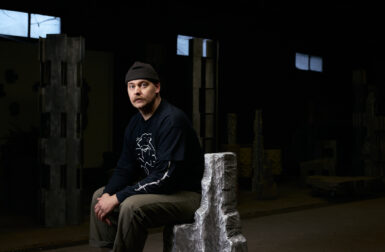
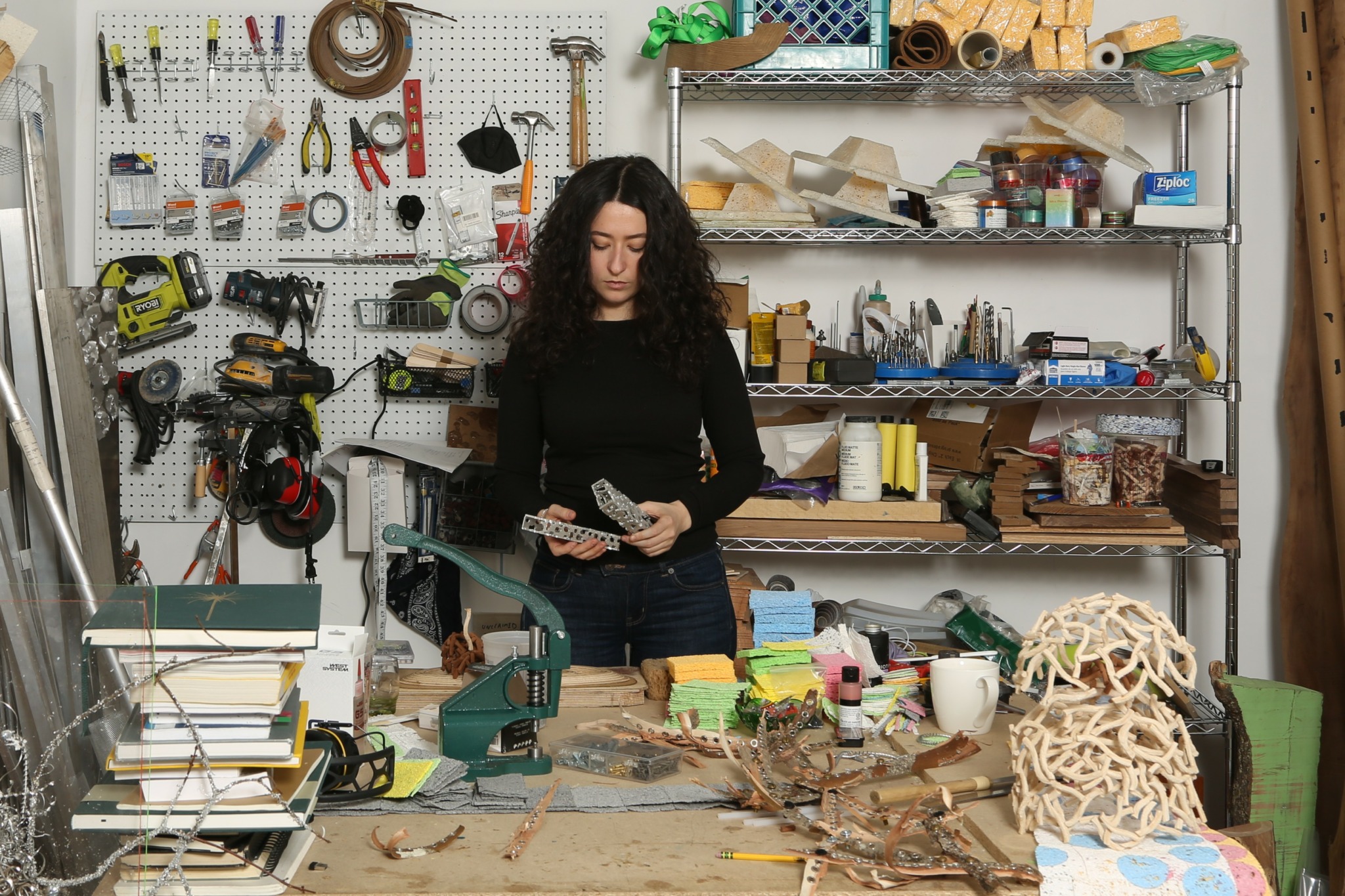


Though she’s still pursuing her MFA in Visual Arts at Columbia University, artist Shaina Tabak is hardly a newcomer to the art world. The RISD graduate, who earned her BFA in furniture design, already has more than 20 exhibitions under her belt. Now she’s adding curator to her résumé with 260 Madison, an artist-run exhibition bringing together more than 50 artists across a former Duane Reade storefront and a 23,000-square-foot office floor above it in Midtown Manhattan.
Tabak’s own work is equally expansive. Drawing on history, technology, and materiality, she explores the relationship between the digital and physical worlds, often starting with digitally modeled forms that she translates into sculptures through hands-on processes such as cutting, perforation, lamination, and extrusion.

‘On Certainties (streetlight)’ (2026) by Anthony Discenza and ‘Arbor Armor’ (2015–2026) by Yasue Maetake on display at ‘260 Madison.’ Photography courtesy of Shaina Tabak.
But her interest in materials extends beyond their physical properties. She also sees them as records of labor, manufacturing, extraction, and use. Her work examines contemporary material culture through a historical lens, imagining how the things made and valued today might be understood generations from now. As she puts it, her sculptures are “less concerned with imagining the future than with creating historical distance from the present.”
That perspective comes through in her recent work, which examines the increasingly blurred line between looking and shopping. In her Brooklyn studio, the Queens-born artist has been embedding collected industrial objects in three-ply cardboard, referencing the packaging and shipping systems that support consumer culture. She’s also exploring the influence of visual search and algorithmic commerce, where objects spotted in an image can lead to an endless stream of purchasable alternatives. It’s a commentary on a culture in which images don’t just inspire desire; they generate transactions.

‘First Water (deer)’ and ‘First Water (banner)’ (2026) by Dexter Barker-Glenn on view at ‘260 Madison.’ Photography courtesy of Shaina Tabak.
For today’s Friday Five, we spent five minutes with Shaina Tabak to explore the ideas behind her curatorial debut at 260 Madison and the influences shaping her own work in the exhibition.

‘Ghosts’ (2025) by Alisa Berger and ‘Big Red Piece’ (2026) by Kari Cholnoky on view at ‘260 Madison.’ Photography courtesy of Shaina Tabak.
The Project: ‘260 Madison’
For her curatorial debut, Tabak drew on Columbia University’s MFA community and her own network of artists, bringing together emerging talents and established names. Co-curated by artistic duo Dayana Matasheva and Edson Niebla Rodríguez of Demon Lovers, Inc., 260 Madison includes artists such as Simon Denny, Jon Kessler, and Eva and Franco Mattes. The exhibition was organized in collaboration with the building’s owner, AmTrustRE, which gave the curators full creative control.

‘Longcat’ (2026) by Eva & Franco Mattes on view at ‘260 Madison.’ Photography courtesy of Shaina Tabak.
On view through Nov. 22, 2026, the expansive exhibition brings together familiar materials, objects, and technologies that are dismantled, reconstructed, or made strange. Exposed HVAC, ripped-out toilets, and corporate-logo wallpaper create the backdrop for works spanning sculpture, new media, and video. Tabak’s goal for 260 Madison is to “examine the systems organizing contemporary life—from control, surveillance, AI, and extraction to the material and architectural structures that shape how we work, move, and live.”
Below, in her own words, Tabak shares the influences that shaped her approach to 260 Madison, from artist-run exhibitions that challenged traditional institutions to architectural theories and sculptures that informed her own work.

Shaina Tabak’s works ‘Localized Collapse / Frozen Zone’ (2026) and ‘Sweep Towards Skylight’ (2026) on view at ‘260 Madison.’ Photography courtesy of the artist.
What Inspired 260 Madison?
2 Exhibitions That Set a Precedent
“The first one, Damien Hirst’s Freeze (1988), was suggested to me by my professor Jon Kessler. Freeze was particularly compelling because it took place amid the redevelopment of London’s Docklands and was itself supported by real-estate developers, revealing the uneasy relationship between artistic independence and the production of urban capital. That history made me particularly conscious of a contradiction in our own project: While 260 Madison temporarily interrupts the building’s commercial function, the exhibition also generates cultural value for a property undergoing modernization.”
“A more recent exhibition, Christopher Wool’s See Stop Run (2024), took place in New York City’s Financial District and demonstrated how artists could operate outside established institutions by appropriating vacant commercial spaces. Wool’s exhibition was also installed on a gutted office floor and offered a more immediate architectural reference, allowing the building’s exposed infrastructure and traces of demolition to enter into dialogue with the work. With 260 Madison, we wanted to push these precedents even further, treating the vacant corporate office as a material record of changing relationships between labor, capital, and the built environment.”

Photography courtesy of Shaina Tabak
The Writing of Rem Koolhaas
“Rem Koolhaas’ book Delirious New York and his essay “Junkspace” were really helpful in connecting the architecture of the space to the exhibition. My partner has worked on the 17th floor of 260 Madison for the past three years—a complete coincidence—and his 9-to-5 job as a paralegal brought to mind Koolhaas’ concepts of the vertical schism, architectural lobotomy, and definitive instability as I considered the exhibition’s function.”
“All three of Koolhaas’ concepts, in their own ways, describe the Manhattan skyscraper as a structure in which the exterior remains independent of the interior, allowing different floors to accommodate radically different and constantly changing activities without altering the building’s outward appearance.”
Rachel Whiteread’s ‘House’ (1993)
“I was thinking about House, a temporary public sculpture by Rachel Whiteread, when creating my sculpture Swept Towards Skylight (2026) for 260 Madison. I embedded an earlier work in insulation foam and coated it with cement to give the illusion that the negative space around it had been cast solid. Whiteread’s work transformed the interior of a house slated for demolition into a concrete monument to its former inhabitants and the lives that had occupied it.”
“I kept returning to this idea while curating 260 Madison, where the vacant office floor still bears physical traces of the labor and routines that once animated it. I wanted the building to function not simply as a container for artworks, but as an artifact in its own right, with its exposed infrastructure and signs of abandonment becoming part of the exhibition. What interests me about House, and what I hoped to capture at 260 Madison, was how architecture outlives its function and becomes a monument to the systems that once gave it meaning.”
260 Madison is on view through Nov. 22, 2026, at 260 Madison Avenue in New York City.